The menstrual cycle influences not only your mood or energy.
Hormones, particularly oestrogens and progesterones, play a direct role in the condition of your skin: sebum production, sensitivity, hydration, and also the appearance of imperfections.
So understanding how your cycle affects your skin allows you to adapt your skincare to maintain a more balanced skin at each phase of the menstrual cycle.
What is the link between the menstrual cycle and skin?
The menstrual cycle influences not only your periods, it affects your entire body, particularly your skin.
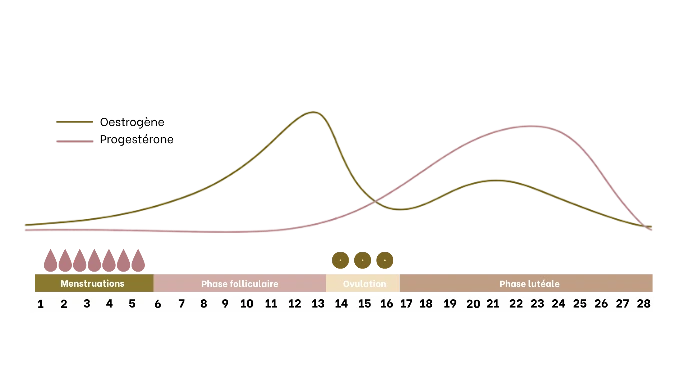
The two main hormones that play a major role in the cycle are oestrogens and progesterone. The variations of these hormones throughout the month lead to different changes in your body, including your skin, which is the largest organ of the human body.
These hormonal fluctuations can affect several skin aspects: sebum production, hydration, inflammation, or even skin sensitivity.
The brightness of your skin, its texture, or the appearance of imperfections can vary depending on the phase of your menstrual cycle.
Oestrogens play an important role in hydration, elasticity, and radiance of the skin. When they increase, the skin is often more supple and luminous.
While progesterone stimulates the production of sebum and can make the skin more sensitive. When progesterone is at its peak, the skin may appear oilier, the pores are more visible, and spots may appear.
For example, it is common to notice that the skin is oilier and that spots have appeared just before the period.
How does the skin evolve during the cycle?
Menstrual phase: more sensitive and dull skin
At the beginning of the cycle, during the period, hormone levels are at their lowest.
Hormones directly influence the state of the skin, which becomes weakened.
This hormonal drop can make the skin duller, more sensitive, and drier. Some people also notice a feeling of discomfort or tightness during this period.
The lack of oestrogen leads to a decrease in the skin's natural hydration, which can affect its radiance. The skin can also become more reactive, as hormonal fluctuations temporarily weaken the skin barrier.
Follicular phase: the skin regains its radiance
After the period, during the follicular phase, the skin gradually regains its balance. It appears more hydrated, more supple, and more radiant.
This improvement is linked to the gradual rise of oestrogen. These hormones play an essential role in the production of collagen, elastin, and in maintaining good skin hydration. The complexion then appears fresher, and the skin is more plump and regains its radiance.
Ovulation: the skin at its prime
Around ovulation, oestrogen levels peak. This phase is often when the skin appears most balanced, the complexion is radiant, and the skin is more supple.
Generally, during this period you feel more confident.
Oestrogens promote hydration and support collagen production, which can give the skin a smoother and more radiant appearance. Some people also notice fewer imperfections during this time.
This is often the time in the cycle when the skin requires the least correction and appears naturally healthier.
Luteal phase
After ovulation, the body enters the luteal phase. During this time, progesterone increases, which can further stimulate sebum production.
The skin can then become oilier, especially in the T-zone (forehead, nose, and chin). Pores may appear more visible and imperfections may arise, particularly a few days before menstruation.
These changes are linked to the natural hormonal fluctuations of the cycle.
Adapting your routine at this time, with balancing and soothing care, can help better support the skin.
To remember: The skin does not have the same needs throughout your menstrual cycle. Adapting your routine means better understanding and respecting its natural balance.
How to adapt your skincare routine to your hormonal cycle?
Your skin does not have the same needs according to hormonal fluctuations.
During menstruation: prioritise hydration and comfort
During this time, it is necessary to counteract the effects of the drop in hormones. Your skin needs to be nourished and comforted.
To hydrate your skin, you can favour rich moisturising creams, and you can use soothing treatments if your skin is irritated or has redness.
When cleansing your skin, you must not aggress the epidermis, so opt for a gentle makeup remover and cleanser, such as a cleansing oil and a cleansing gel.
To nourish and protect your skin, you can use vegetable oils or nourishing creams. The goal is to restore its suppleness and a plump appearance. And don't forget to protect your skin from the sun by applying SPF. Sunscreen should always be applied at the end of your morning routine.
Finally, during this phase, do not use aggressive treatments, such as "Peel-off" masks or intense grain scrubs.
The skin is more reactive to UV during this period, so don't forget to apply effective sun protection.
In summary, during your period your skin needs protection and comfort. Hydration, soothing, and gentleness are the key words to remember for taking care of your skin during this phase.
During the follicular phase
The skin's radiance gradually returns during the follicular phase. This is due to the gradual rise in oestrogen. The skin is also more receptive to treatments.
This is the ideal time to help your skin regain its glow and erase the fatigue from your period.
You need to maintain your skin's hydration, for this, favour light textures like serums. You should hydrate without overloading the skin.
Continue to use gentle cleansers
And apply antioxidants, such as vitamin C, to protect your skin. To stimulate collagen production, prioritise stimulating treatments, particularly with ingredients like Buckachiol and Nephoria.
In summary, you should take advantage of this phase to stimulate the skin's radiance and its regeneration.
During ovulation
During ovulation, the skin is thicker, hydrated, and radiant thanks to the peak in oestrogen.
You need to help the skin maintain its natural glow; you can use glow-boosting actives like GlowCytocin. You can also do gentle scrubs or peel-off masks to enhance this glow.
Skin hydration is generally balanced during this period; a light cream is sufficient. Or for example, hydrate with hyaluronic acid to prepare for the next phase.
In summary, during ovulation, the skin needs maintenance to keep its natural glow.
During the luteal phase
The increase in progesterone makes the skin oilier, and imperfections are more likely to appear.
The skin needs help to regulate sebum. You can incorporate regulating actives into your routine, such as zinc or salicylic acid.
Prioritise non-comedogenic treatments to avoid clogging the pores.
And to soothe potential inflammation due to premenstrual acne, use soothing ingredients like aloe vera or cucumber.
In summary, during the luteal phase, your skin requires control and soothing.
Can you really synchronise your routine with your cycle?
Yes, it is possible!
You can achieve this in several ways.
Listen to your body. Some women feel changes in their bodies when they change phase. This can be noticed, for example, with the increase in libido during the ovulation phase.
Listen to your skin. When you notice that your skin is changing, it may be a sign of a phase change. For example, in the luteal phase, you may feel your skin is more radiant and/or observe the appearance of spots.
Use an app. There are different apps to track your menstrual cycle. You can try one and see if it suits you!
But be careful, apps are not precise; they are just estimates. Each woman has a different cycle.